Read the issue terms
The final terms and base prospectus show whether there is a delivery claim and whether the issuer may pay cash instead. The product page is not enough.
If you live in Germany and hold a Bitcoin or Ether ETP in your brokerage account, the tax treatment does not follow the product name. It follows the issue terms. Where you have an enforceable claim to delivery of the coins, the tax administration treats the note like coins held directly: section 23 EStG, one-year holding period, tax free afterwards. Where that claim is missing, it is a capital claim under section 20 EStG with the 25 per cent flat tax. This article explains the test, the legal sources and where the law is not yet settled.
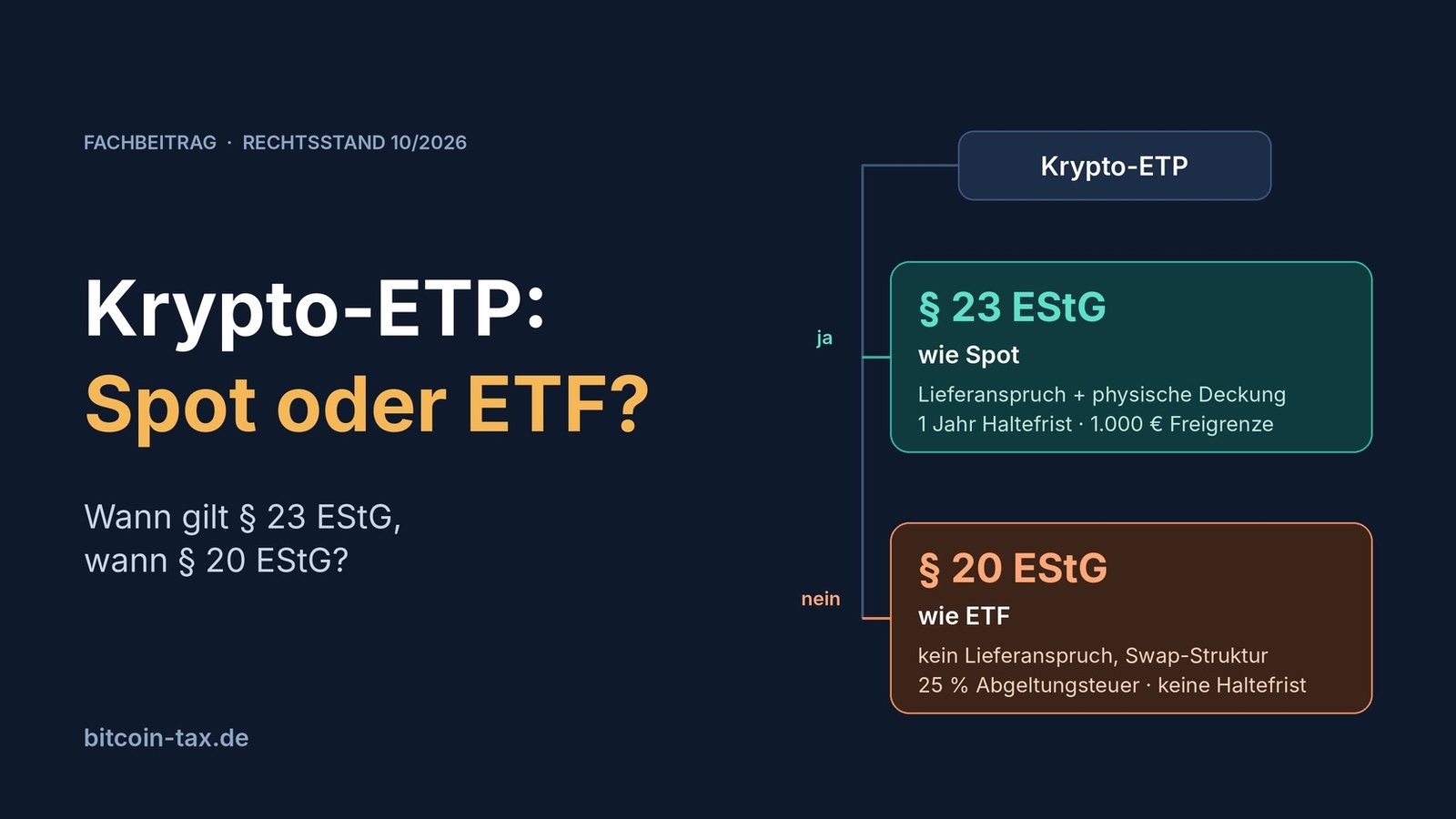
ETP is an umbrella term for exchange-traded products: ETFs, ETCs and ETNs. The crypto ETPs listed on German exchanges are bonds issued by the provider, not fund units. That is why single-asset Bitcoin products exist at all: an ETF must meet the diversification rules for investment funds, a single-asset ETF is not permitted in the EU, and crypto assets are not yet an eligible ETF underlying. A fund holding only Bitcoin would also breach the 20 per cent UCITS limit.
For tax this gives a first fork in the road:
The rest of this article is about the first group only.
The administration looks at the claim the bond embodies, not at the product label.
Under margin no. 83 of the Finance Ministry circular of 6 March 2025, the question is whether the bond creates a capital claim within section 20(1) no. 7 EStG or merely a claim to delivery of goods. Margin no. 84 answers it for crypto: if the bond gives exclusively a claim to delivery of a fixed quantity of crypto assets deposited with the issuer, or to the proceeds from their sale by the issuer, there is no capital claim. The Federal Fiscal Court's rulings on Xetra-Gold and Gold Bullion Securities are to be applied accordingly.
Without a delivery claim the default applies: the bond is a capital claim under section 20(1) no. 7 EStG, and the gain on sale or redemption is taxable under section 20(2) sentence 1 no. 7 EStG (margin no. 86). There is no holding period; the 25 per cent flat tax plus solidarity surcharge and church tax where applicable is due even after years. Losses go into the general capital-income loss pot. Your German bank normally withholds the tax itself.
| Feature | Crypto ETP with delivery claim | Crypto ETP without delivery claim | Investment fund (e.g. US spot ETF) |
|---|---|---|---|
| Legal form | bearer bond | bearer bond | fund unit |
| Rule | section 23 EStG | section 20 EStG | Investment Tax Act |
| Holding period | one year, then tax free | none | none |
| Rate | your personal rate | 25% flat tax + surcharge, church tax if applicable | 25% flat tax, partial exemption 0% |
| Allowance | €1,000 limit per year (all private disposals) | saver\'s allowance | saver\'s allowance, annual advance lump sum |
| Bank withholds tax | should not; in practice sometimes does | yes | usually no |
| Return form | Annex SO | Annex KAP | Annex KAP-INV |
Administration: Finance Ministry circular of 6 March 2025 on the income taxation of crypto assets, margin nos. 83 to 86 (bonds referencing crypto assets) and 53 (exemption limit).
Case law on gold bonds, applied by analogy: BFH 12 May 2015, VIII R 35/14 and VIII R 4/15 (Xetra-Gold: taxable only under section 23, not section 20); BFH 6 February 2018, IX R 33/17 (redemption against delivery of gold is not a disposal); BFH 16 June 2020, VIII R 7/17 (Gold Bullion Securities: the issuer must invest almost all capital in gold and have no free use of it); BFH 14 February 2023, IX R 3/22 (cryptocurrencies are other assets within section 23 EStG).
As far as we can establish, there is no ruling by the Federal Fiscal Court or any fiscal court on crypto ETPs themselves. Applying the Xetra-Gold line to crypto rests on the administration\'s view. The circular does not bind the courts.
The German version of this article also discusses a concrete issuer, nxtAssets, whose products are marketed as physically backed with a delivery option for investors. We have not reviewed its final terms and base prospectus in detail; the section 23 classification is a working assumption based on the product information. Read the example (in German).
Tax is only part of the decision. Two situations where the wrapper makes the difference: inheritance, and being asked where the money came from.
| Question | Crypto ETP in a brokerage account | Coins on a hardware wallet |
|---|---|---|
| What passes to the heirs? | The bond in the account. The bank re-registers it against a certificate of inheritance or the opened will. | Legally the claim to the coins. Without the seed or private key that is worth nothing; the coins stay where they are. |
| Inheritance tax | Arises on death, valued at the price on the date of death. The bank reports the holding to the tax office. | Arises on death at the same value, even if nobody can access the coins. The only remedies are a valuation reflecting inaccessibility and equity applications; both are laborious and uncertain. |
| What the heirs need | Inheritance papers and the account statements. Proof of purchase sits with the bank. | Seed phrase or private key with instructions, plus the purchase and transaction history, all kept separately from the will, which is opened and read out. |
| Who has already checked the origin of the money? | The bank, under anti-money-laundering rules, when the account was opened and funded. | Nobody, as long as the coins never passed through a regulated exchange. The check comes when you sell, withdraw or are asked. |
| How fast can you prove the origin? | In days: purchase confirmation, statements, tax certificate. | Days to months, depending on the history: exchange records, bank statements for the euro deposits and the chain of transfers to today\'s address. |
| Why it may matter from 2027 | A draft Customs Finance Justice Act (Zollfinanzgerechtigkeitsgesetz) would, according to reports, let customs open an administrative procedure to confiscate assets of unclear origin outside any criminal case, normally from more than €100,000, without needing a criminal suspicion; founded doubts about lawful origin would be enough, with review by the fiscal courts. Status: cabinet 12 August 2026, first reading 9 October 2026, committee hearing 2 November 2026, planned start 1 January 2027. Not yet law, and the reports do not say whether crypto assets are named expressly. Either way: an ETP comes with its paper trail, a wallet does not. | |
| Typical risk | Issuer risk: the ETP is a claim against the issuer. Check how the backing is protected in insolvency. | Losing access while remaining fully taxable; and a seizure you cannot answer without a source-of-funds file. |
More: Inheritance and gifts and Source of funds for banks. Details of the customs bill as reported on 22 October 2026, not official.
The final terms and base prospectus show whether there is a delivery claim and whether the issuer may pay cash instead. The product page is not enough.
If the bank taxed a crypto ETP under section 20 EStG although section 23 applies, you can correct this in your return, with documents and a reasoned explanation.
Purchase date, cost and the issue terms in force, so you can prove the holding period later.
For larger positions a binding ruling from the tax office under section 89(2) AO can be worthwhile.
For crypto ETPs this means: if you buy now, run both scenarios. Products that fall under section 23 EStG today would also be caught by a new rule for new purchases.