News New cabinet date 9 December 2026: the draft 25 % flat tax on crypto is back on the table; the one-year holding period applies until the law is promulgated To the timeline →
§ 23 EStG German tax practice · Potsdam · Barcelona · Dubai

Your crypto tax advisor in Germany, in your language.

If you live in Germany, your crypto is taxed under German rules — whichever exchange you used and wherever you are from. We handle the filing, deal with the tax office, and explain every figure in English before anything is submitted.

Matthias Steger Matthias Steger
German certified tax adviser, nine years as a tax auditor
Anlage SO · lines 42 ff. Tax year 2025
Disposals within the 12-month period€18,400
Wallet transfer booked as a sale. Not a disposal — tax base overstated.
Staking rewards, other income€0
2025 inflow not recorded. Sec. 22 no. 3 EStG, €256 limit exceeded.
Held > 12 months, tax free€64,900
FIFO run across all exchanges. Per-address evidence missing.
Findings we see in ongoing audits Audit note
Top topic As at 21 November 2026

When will Germany's 25 % tax on crypto arrive? The timeline to entry into force

The Federal Cabinet is due to discuss the bill reforming the taxation of crypto assets on 9 December 2026. After that, the sitting calendars of the Bundestag and Bundesrat decide when the law can apply at the earliest. As a tax law requiring the consent of the Bundesrat (Art. 105(3) Basic Law), it needs the Bundesrat's approval in the second passage. Until promulgation, the one-year holding period continues to apply unchanged.
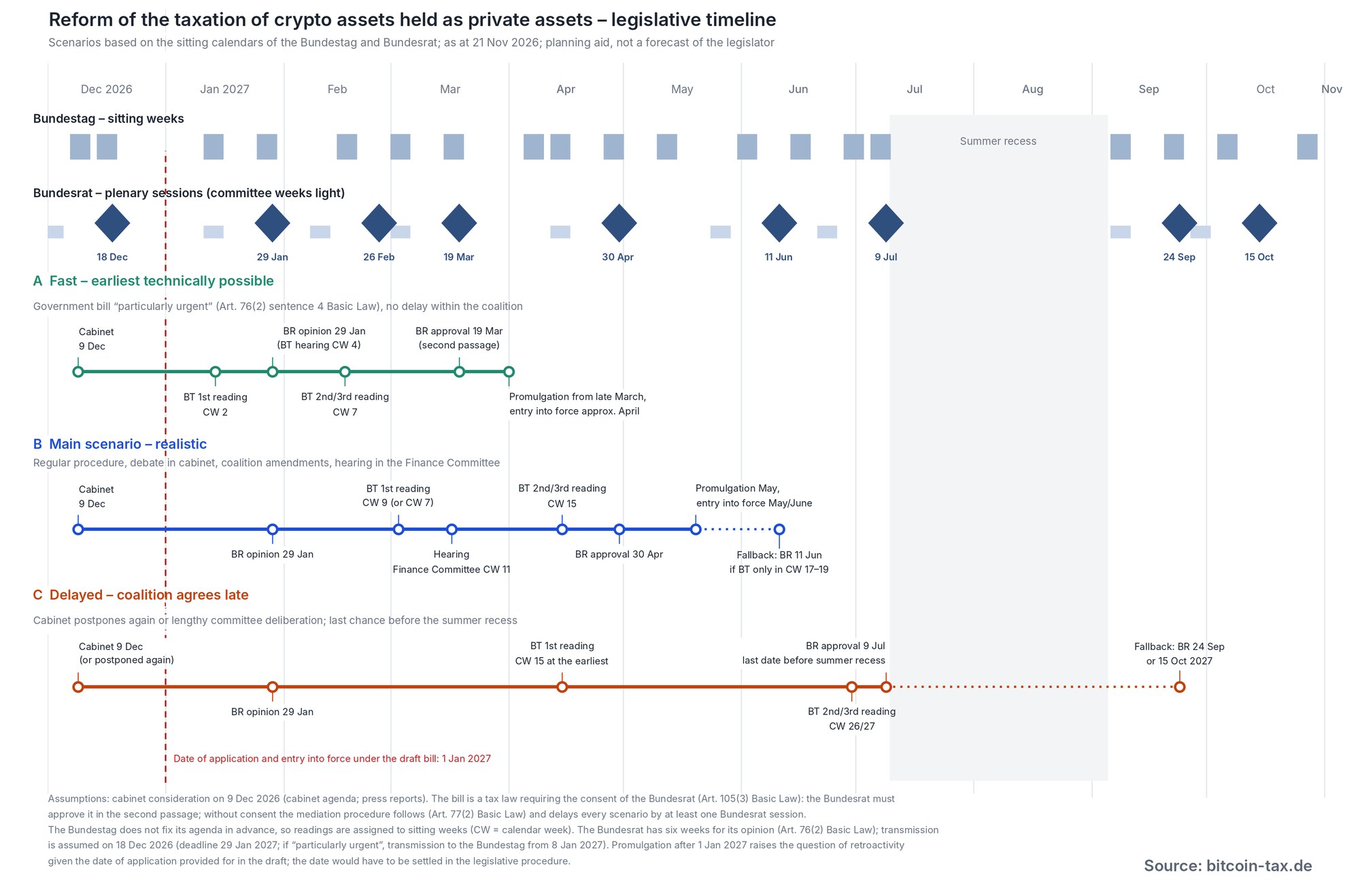
Timeline of the German crypto tax reform: Bundestag sitting weeks and Bundesrat plenary sessions December 2026 to October 2027, with three scenarios from the cabinet date of 9 December 2026 – A fast (promulgation from late March 2027), B main scenario (promulgation May 2027), C delayed (Bundesrat approval 9 July 2027, fallback autumn 2027).
Scenarios based on the sitting calendars of Bundestag and Bundesrat, as at 21 November 2026. Planning aid, not a forecast of the legislator. Source: bitcoin-tax.de. Click to enlarge.
A · fast

Promulgation from late March 2027

Government bill marked “particularly urgent” (Art. 76(2) sentence 4 Basic Law), no delay within the coalition: Bundestag 2nd/3rd reading in calendar week 7, Bundesrat approval on 19 March 2027.

B · main scenario

Promulgation in May 2027

Regular procedure with a hearing in the Finance Committee: Bundestag 2nd/3rd reading in calendar week 15, Bundesrat approval on 30 April 2027, entry into force May/June. Fallback: Bundesrat on 11 June.

C · delayed

Bundesrat only in July or autumn 2027

The coalition agrees late: Bundestag 2nd/3rd reading in calendar weeks 26/27, Bundesrat on 9 July 2027 as the last date before the summer recess. Fallback: 24 September or 15 October 2027.

What this means for you
  • The draft bill names 1 January 2027 as the date of application. In all three scenarios the law is promulgated after that date – whether it then applies retroactively has to be settled in the legislative procedure.
  • Under the draft, crypto assets acquired by 31 December 2026 are existing holdings and remain tax-free after one year. Check your holdings and records now, not after promulgation.
  • We will update the timeline after the cabinet meeting on 9 December 2026.
  • Nine years as a German tax auditor
  • Active in crypto since 2016
  • Expert witness before the Bundestag finance committee
  • Co-organiser of the Blockchain Roundtable in the Bundestag
  • Author, standard German handbook on crypto taxation
  • Named among Germany’s best tax advisers 2024
  • Own offices in Barcelona and Dubai

Your quick check in one minute

Pick a topic, answer one to three questions and get an assessment straight away. No data is sent.

Do I owe German tax on my sale or my crypto income?

12 monthsholding period, section 23 EStG
€1,000exemption limit, private disposals
€256exemption limit, staking and lending
What did you do? Tick all that apply.
How long was it between buying and selling?
What is your total gain from private disposals in this calendar year?
How much did you earn from staking, lending and similar services this calendar year?
Your result appears here once you have answered the questions.

All clear

Tax free

Filing obligation
Nono taxable event
Section 22 no. 3 EStG
No
Section 23 EStG
Noperiod has passed
Voluntary filing
Optionalkeep your purchase records

If more than twelve months lie between acquisition and disposal, the gain is tax free for private assets (section 23 EStG), whatever the amount. That also holds if the coins were staked or lent in between. In a swap, the coins you receive start a new period. You must be able to prove the acquisition. It does not apply to commercial trading.

All clear

No tax: below the exemption limit

Filing obligation
Yestaxable event, Annex SO
Section 22 no. 3 EStG
No
Section 23 EStG
Yes, tax freebelow €1,000
Voluntary filing
Not neededyou are obliged to file

Gains from private disposals stay tax free up to €1,000 per calendar year. This is an exemption limit, not an allowance: once it is reached, the whole gain is taxable. Declare losses anyway, because only assessed losses can be offset.

Attention

Taxable

Filing obligation
YesAnnex SO
Section 22 no. 3 EStG
No
Section 23 EStG
Yesfrom €1,000 the whole amount
Voluntary filing
Not neededyou are obliged to file

Within the twelve months the gain is taxed at your personal income tax rate. From €1,000 the whole amount is taxable, not just the excess. It belongs in Annex SO of your return.

Take care

Work out the gain first

Filing obligation
Openwork out the gain first
Section 22 no. 3 EStG
No
Section 23 EStG
Yeswithin the period
Voluntary filing
Recommendedrecord all data completely

Whether you reach the €1,000 limit depends on all sales and swaps of the year, across exchanges. Without complete transaction data you cannot say for sure.

Take care

Prove the acquisition first

Filing obligation
Openprove the acquisition first
Section 22 no. 3 EStG
No
Section 23 EStG
Openperiod per tranche
Voluntary filing
Recommendedrecord all data completely

You must be able to show per tranche whether twelve months have passed, not in general terms. If data is missing, that is the first job, before you declare anything.

Attention

Taxable

Filing obligation
YesAnnex SO
Section 22 no. 3 EStG
Yesfrom €256 the whole amount
Section 23 EStG
Noonly on a later sale
Voluntary filing
Not neededyou are obliged to file

Staking and lending rewards are other income (section 22 no. 3 EStG) when they are credited, even if you never sold. From €256 the entire amount is taxable. A later sale is a separate event under section 23 EStG.

All clear

No tax: below the exemption limit

Filing obligation
Yestaxable event, Annex SO
Section 22 no. 3 EStG
Yes, tax freebelow €256
Section 23 EStG
No
Voluntary filing
Not neededyou are obliged to file

If income from staking, lending and similar services stays below €256 in the calendar year, it is tax free. Add up every source of the year, valued at the price when credited.

Take care

Add up your rewards

Filing obligation
Openadd up your rewards first
Section 22 no. 3 EStG
Open€256 limit
Section 23 EStG
No
Voluntary filing
Recommendedrecord all data completely

The total of all rewards in the year counts, valued at the price on each credit. That can only be said from complete transaction data.

Attention

Sale: Tax free · Rewards: Taxable

Filing obligation
YesAnnex SO
Section 22 no. 3 EStG
Yesfrom €256 the whole amount
Section 23 EStG
Noperiod has passed
Voluntary filing
Not neededyou are obliged to file

If more than twelve months lie between acquisition and disposal, the gain is tax free for private assets (section 23 EStG), whatever the amount. That also holds if the coins were staked or lent in between. In a swap, the coins you receive start a new period. You must be able to prove the acquisition. It does not apply to commercial trading.

Staking and lending rewards are other income (section 22 no. 3 EStG) when they are credited, even if you never sold. From €256 the entire amount is taxable. A later sale is a separate event under section 23 EStG.

All clear

Sale: Tax free · Rewards: No tax: below the exemption limit

Filing obligation
Yestaxable event, Annex SO
Section 22 no. 3 EStG
Yes, tax freebelow €256
Section 23 EStG
Noperiod has passed
Voluntary filing
Not neededyou are obliged to file

If more than twelve months lie between acquisition and disposal, the gain is tax free for private assets (section 23 EStG), whatever the amount. That also holds if the coins were staked or lent in between. In a swap, the coins you receive start a new period. You must be able to prove the acquisition. It does not apply to commercial trading.

If income from staking, lending and similar services stays below €256 in the calendar year, it is tax free. Add up every source of the year, valued at the price when credited.

Take care

Sale: Tax free · Rewards: Add up your rewards

Filing obligation
Openadd up your rewards first
Section 22 no. 3 EStG
Open€256 limit
Section 23 EStG
Noperiod has passed
Voluntary filing
Recommendedrecord all data completely

If more than twelve months lie between acquisition and disposal, the gain is tax free for private assets (section 23 EStG), whatever the amount. That also holds if the coins were staked or lent in between. In a swap, the coins you receive start a new period. You must be able to prove the acquisition. It does not apply to commercial trading.

The total of all rewards in the year counts, valued at the price on each credit. That can only be said from complete transaction data.

Attention

Sale: No tax: below the exemption limit · Rewards: Taxable

Filing obligation
Yestaxable event, Annex SO
Section 22 no. 3 EStG
Yesfrom €256 the whole amount
Section 23 EStG
Yes, tax freebelow €1,000
Voluntary filing
Not neededyou are obliged to file

Gains from private disposals stay tax free up to €1,000 per calendar year. This is an exemption limit, not an allowance: once it is reached, the whole gain is taxable. Declare losses anyway, because only assessed losses can be offset.

Staking and lending rewards are other income (section 22 no. 3 EStG) when they are credited, even if you never sold. From €256 the entire amount is taxable. A later sale is a separate event under section 23 EStG.

All clear

Sale: No tax: below the exemption limit · Rewards: No tax: below the exemption limit

Filing obligation
Yestaxable event, Annex SO
Section 22 no. 3 EStG
Yes, tax freebelow €256
Section 23 EStG
Yes, tax freebelow €1,000
Voluntary filing
Not neededyou are obliged to file

Gains from private disposals stay tax free up to €1,000 per calendar year. This is an exemption limit, not an allowance: once it is reached, the whole gain is taxable. Declare losses anyway, because only assessed losses can be offset.

If income from staking, lending and similar services stays below €256 in the calendar year, it is tax free. Add up every source of the year, valued at the price when credited.

Take care

Sale: No tax: below the exemption limit · Rewards: Add up your rewards

Filing obligation
Yestaxable event, Annex SO
Section 22 no. 3 EStG
Open€256 limit
Section 23 EStG
Yes, tax freebelow €1,000
Voluntary filing
Not neededyou are obliged to file

Gains from private disposals stay tax free up to €1,000 per calendar year. This is an exemption limit, not an allowance: once it is reached, the whole gain is taxable. Declare losses anyway, because only assessed losses can be offset.

The total of all rewards in the year counts, valued at the price on each credit. That can only be said from complete transaction data.

Attention

Sale: Taxable · Rewards: Taxable

Filing obligation
YesAnnex SO
Section 22 no. 3 EStG
Yesfrom €256 the whole amount
Section 23 EStG
Yesfrom €1,000 the whole amount
Voluntary filing
Not neededyou are obliged to file

Within the twelve months the gain is taxed at your personal income tax rate. From €1,000 the whole amount is taxable, not just the excess. It belongs in Annex SO of your return.

Staking and lending rewards are other income (section 22 no. 3 EStG) when they are credited, even if you never sold. From €256 the entire amount is taxable. A later sale is a separate event under section 23 EStG.

Attention

Sale: Taxable · Rewards: No tax: below the exemption limit

Filing obligation
YesAnnex SO
Section 22 no. 3 EStG
Yes, tax freebelow €256
Section 23 EStG
Yesfrom €1,000 the whole amount
Voluntary filing
Not neededyou are obliged to file

Within the twelve months the gain is taxed at your personal income tax rate. From €1,000 the whole amount is taxable, not just the excess. It belongs in Annex SO of your return.

If income from staking, lending and similar services stays below €256 in the calendar year, it is tax free. Add up every source of the year, valued at the price when credited.

Attention

Sale: Taxable · Rewards: Add up your rewards

Filing obligation
YesAnnex SO
Section 22 no. 3 EStG
Open€256 limit
Section 23 EStG
Yesfrom €1,000 the whole amount
Voluntary filing
Not neededyou are obliged to file

Within the twelve months the gain is taxed at your personal income tax rate. From €1,000 the whole amount is taxable, not just the excess. It belongs in Annex SO of your return.

The total of all rewards in the year counts, valued at the price on each credit. That can only be said from complete transaction data.

Attention

Sale: Work out the gain first · Rewards: Taxable

Filing obligation
YesAnnex SO
Section 22 no. 3 EStG
Yesfrom €256 the whole amount
Section 23 EStG
Yeswithin the period
Voluntary filing
Not neededyou are obliged to file

Whether you reach the €1,000 limit depends on all sales and swaps of the year, across exchanges. Without complete transaction data you cannot say for sure.

Staking and lending rewards are other income (section 22 no. 3 EStG) when they are credited, even if you never sold. From €256 the entire amount is taxable. A later sale is a separate event under section 23 EStG.

Take care

Sale: Work out the gain first · Rewards: No tax: below the exemption limit

Filing obligation
Yestaxable event, Annex SO
Section 22 no. 3 EStG
Yes, tax freebelow €256
Section 23 EStG
Yeswithin the period
Voluntary filing
Not neededyou are obliged to file

Whether you reach the €1,000 limit depends on all sales and swaps of the year, across exchanges. Without complete transaction data you cannot say for sure.

If income from staking, lending and similar services stays below €256 in the calendar year, it is tax free. Add up every source of the year, valued at the price when credited.

Take care

Sale: Work out the gain first · Rewards: Add up your rewards

Filing obligation
Openwork out the gain first
Section 22 no. 3 EStG
Open€256 limit
Section 23 EStG
Yeswithin the period
Voluntary filing
Recommendedrecord all data completely

Whether you reach the €1,000 limit depends on all sales and swaps of the year, across exchanges. Without complete transaction data you cannot say for sure.

The total of all rewards in the year counts, valued at the price on each credit. That can only be said from complete transaction data.

Attention

Sale: Prove the acquisition first · Rewards: Taxable

Filing obligation
YesAnnex SO
Section 22 no. 3 EStG
Yesfrom €256 the whole amount
Section 23 EStG
Openperiod per tranche
Voluntary filing
Not neededyou are obliged to file

You must be able to show per tranche whether twelve months have passed, not in general terms. If data is missing, that is the first job, before you declare anything.

Staking and lending rewards are other income (section 22 no. 3 EStG) when they are credited, even if you never sold. From €256 the entire amount is taxable. A later sale is a separate event under section 23 EStG.

Take care

Sale: Prove the acquisition first · Rewards: No tax: below the exemption limit

Filing obligation
Yestaxable event, Annex SO
Section 22 no. 3 EStG
Yes, tax freebelow €256
Section 23 EStG
Openperiod per tranche
Voluntary filing
Not neededyou are obliged to file

You must be able to show per tranche whether twelve months have passed, not in general terms. If data is missing, that is the first job, before you declare anything.

If income from staking, lending and similar services stays below €256 in the calendar year, it is tax free. Add up every source of the year, valued at the price when credited.

Take care

Sale: Prove the acquisition first · Rewards: Add up your rewards

Filing obligation
Openprove the acquisition first
Section 22 no. 3 EStG
Open€256 limit
Section 23 EStG
Openperiod per tranche
Voluntary filing
Recommendedrecord all data completely

You must be able to show per tranche whether twelve months have passed, not in general terms. If data is missing, that is the first job, before you declare anything.

The total of all rewards in the year counts, valued at the price on each credit. That can only be said from complete transaction data.

What happens to my coins if I leave Germany?

Sec. 6 AStGshares in corporations
up to 10 yearssection 2 AStG, extended tax liability
18destination countries assessed
Will you keep a home in Germany that is available to you at any time?
Do you hold at least 1% of a corporation (for example a GmbH), including one that holds crypto?
Where are you moving to?
Your result appears here once you have answered the questions.

Attention

You stay tax resident in Germany

Stay German tax resident
Yeshome available at any time
Exit tax, section 6 AStG
Noliability does not end
Extended liability, section 2 AStG
Norequires leaving
Planning before you move
Recommendedsettle before you move

A home you can use at any time is enough to keep unlimited tax liability, whatever the residents' register says. Then the move changes nothing for tax.

Take care

Clarify your residence first

Stay German tax resident
Openclarify residence
Exit tax, section 6 AStG
Open
Extended liability, section 2 AStG
Open
Planning before you move
Recommendedsettle before you move

Whether you stay liable depends on residence and habitual abode, not on deregistering. That should be settled before you move.

Attention

Check exit taxation

Stay German tax resident
No
Exit tax, section 6 AStG
Yesgain in value of the shares
Extended liability, section 2 AStG
Checkdepends on the country
Planning before you move
Recommendedwork it out before you leave

For shares in corporations, section 6 AStG applies: the gain in value of the shares is taxed, and the value of the crypto inside the company feeds into the valuation. Work this out before you leave; afterwards it is only stock-taking.

Take care

Clarify the shareholding first

Stay German tax resident
No
Exit tax, section 6 AStG
Openclarify the shareholding
Extended liability, section 2 AStG
Checkdepends on the country
Planning before you move
Recommendedsettle before you move

Shares in corporations are subject to exit taxation (section 6 AStG); coins held privately are not. First check whether you hold such shares.

Take care

Low-tax country: check section 2 AStG

Stay German tax resident
No
Exit tax, section 6 AStG
Nocoins held privately
Extended liability, section 2 AStG
Checkup to 10 years possible
Planning before you move
Recommendedsettle before you move

Leaving itself does not trigger German tax on crypto held privately. But a German citizen who moves to a low-tax country and keeps substantial economic interests in Germany can remain taxable on certain income for up to ten years (section 2 AStG).

All clear

No German exit tax

Stay German tax resident
No
Exit tax, section 6 AStG
Nocoins held privately
Extended liability, section 2 AStG
Nonot a low-tax country
Planning before you move
Recommendednew country's law and treaty

Leaving itself does not trigger German tax on crypto held privately. The holding period carries on. Whether a later sale is taxed depends on the law of your new country and the tax treaty. That is where the real planning is.

Take care

Clarify the destination first

Stay German tax resident
No
Exit tax, section 6 AStG
Nocoins held privately
Extended liability, section 2 AStG
Opentariff comparison
Planning before you move
Recommendedclarify the destination

Whether a country is low-tax under section 2 AStG depends on a tariff comparison. We have assessed 18 destination countries.

Do I need a tax adviser for my crypto?

from €2,380per tax year, minimum fee
2–6 weeksuntil the return is filed
5 hourstransaction review included
Are earlier years with crypto undeclared or incompletely declared?
How large is your portfolio activity?
Your result appears here once you have answered the questions.

Attention

Clarify first, then act

Voluntary disclosure to consider
Yescomplete, all open years
Doable yourself
Norebuild the data first
Review by us
Recommendedbefore any step

Do not correct anything yourself and do not send documents: a voluntary disclosure must be complete and cover all years not yet time-barred; a partial disclosure does not protect you. The first step is rebuilding the data.

Take care

Clarify your position first

Voluntary disclosure to consider
Opena position check shows it
Doable yourself
Open
Review by us
Recommendedposition check

If you are not sure every year was declared, start with a position check: it shows what is open and how reliable your data is.

All clear

Quite doable yourself

Voluntary disclosure to consider
No
Doable yourself
YesAnnex SO
Review by us
Optionalon request

With one exchange and few transactions you can often prepare Annex SO yourself: export the data, generate a tax report, enter the totals. If you want to be sure, have the result checked.

Take care

A review is worthwhile

Voluntary disclosure to consider
No
Doable yourself
With reviewhave the report reviewed
Review by us
Recommendedbefore you file

With several exchanges and wallets the typical errors arise: transfers between your own addresses booked as sales, the cost-flow method not calculated per wallet. We review your report before you file.

Take care

Better to hand it over

Voluntary disclosure to consider
No
Doable yourself
Noown rules, case by case
Review by us
Recommendedwe take over the filing

Staking, lending, DeFi and mining follow their own rules and need case-by-case assessment. We take over preparation, the return and contact with the tax office. We estimate the effort in advance.

General assessment under current law, as at October 2026. Not individual advice. The ministry draft on a flat tax for crypto is not yet law. For further questions try TaxTobi, our AI assistant.

The quick check needs a current browser (recent Chrome, Safari, Edge or Firefox). You will find all answers in our articles as well.

Germany taxes crypto differently from almost everywhere else

If you arrived from the UK, the US, India or the Netherlands, the rules you already know do not transfer. Four differences catch newcomers out most often.

There is no flat capital gains tax on crypto

Directly held crypto is not treated like shares. Gains fall under private disposal transactions and are taxed at your personal income tax rate, which runs from 0 to 45 percent depending on your total income.

Holding for more than twelve months makes the gain tax free

Not reduced — free, with no ceiling. This is the single most valuable rule in German crypto taxation, and the reason documentation of acquisition dates matters more here than in most jurisdictions.

Coin-to-coin swaps are taxable events

Exchanging Bitcoin for Ethereum is a disposal and starts a fresh twelve-month clock for the asset received. Traders who never cashed out to euro are frequently surprised by this.

The thresholds are limits, not allowances

Reach €1,000 in private disposal gains and the entire amount becomes taxable, not just the excess. The same logic applies to the €256 limit for staking and lending income.

How it works

Three steps. At the end you hold a return you can explain yourself, and evidence that answers the tax office's questions. You deal with people, not a portal: every file crosses Matthias Steger's desk.

Matthias Steger, German tax adviser for crypto assets
Matthias Steger, tax adviser
1

Sort the data

We prepare exports from exchanges and wallets, allocate transfers correctly and separate wallets by address. Missing records are named before the tax office asks.

2

Calculate to an auditor's standard

Holding period, cost-flow method and rewards are calculated and documented so they can be followed. We tell you which method holds in your case and what the tax office might see differently.

3

File and represent

Annex SO and any further annexes, each position derived. We handle queries, appeals and proceedings up to the tax court, and bring open earlier years into order.

Before year-end: review your holdings on 31 December 2026

Holding periods, thresholds, loss offsetting and wallet holdings, checked while you can still decide. Year-end review · Crypto tax advisor in Germany, in English

Services: German crypto tax advice from filing to litigation

The six services asked for most often. Altogether Steger Consulting, a German certified tax practice in Potsdam near Berlin, covers crypto assets across eighteen service areas — from the annual return under section 23 EStG through accounting, VAT and voluntary disclosure to representation before the fiscal courts, plus support for clients moving to or leaving Germany. Clients are advised throughout Germany and internationally, in English.

All eighteen service pages are available in English. Advice itself is given in English throughout – written correspondence, meetings and representation before the tax office and the fiscal courts.

§ 23 EStG

Crypto tax return

Data preparation from exchanges and wallets, cost basis under FIFO or LIFO, clean per-address separation, and a defensible trail for every figure that reaches the Anlage SO form.

See the process →
§ 371 AO

Voluntary disclosure

A complete disclosure covering every unbarred year, prepared before DAC8 data or a collective information request removes the protection it offers.

See the process →
§ 6 AStG

Leaving Germany

What ends your unlimited tax liability, when exit taxation actually bites, and the evidence that must exist before you deregister. Own offices in Barcelona and Dubai; 18 destination countries covered in-house rather than through correspondent firms.

See destinations →
§ 193 AO

Tax audit and defence

Representation during the audit, handling of data requests, and defence in tax criminal proceedings — argued by someone who spent nine years conducting audits.

See the focus →

Arriving in Germany: your first year

Becoming tax resident in Germany starts a chain of registrations, and most of them ask for documents nobody told you to keep. We handle the sequence, from the exit position in the country you are leaving to the paperwork German banks, landlords and authorities will request.

Before

Exit tax in the country you leave

Several countries tax unrealised gains on departure. Coordinated timing, and in some cases a deferral, can avoid being charged twice on the same holdings.

Before

Acquisition records from before you arrived

Germany looks at your original acquisition, not the date you moved. Whether the 12-month rule protects a holding therefore depends on records created long before your arrival — gather them while the accounts still exist.

Step 1

Tax number and first return

Registration with the competent tax office, tax identification number and tax number, and the first German return — including the part-year in which your liability began.

Step 2

Source of funds for banks and exchanges

German banks and regulated exchanges ask where the money came from before they onboard you or release a payout. A prepared trail avoids frozen credits and rejected accounts.

Step 3

Proof of income and certificate of residence

Income confirmations for landlords, visa and residence permit applications, plus the certificate of tax residence you need to claim treaty relief and stop withholding tax abroad.

Step 4

Family benefits and naturalisation

Applications for child benefit, and the tax records required later in a naturalisation file — assembled correctly from the start rather than reconstructed under time pressure.

How a German tax auditor reads your crypto data

Four findings that appear in almost every file. No tax software catches them, because they are not in the numbers — they are in what is missing.

Matthias Steger speaking on a panel
Matthias Steger on stage, June 2026. Photo: Anicka Jerabkova
Finding 01

Wallet transfers booked as sales

Moving coins between your own addresses is not a disposal. Raw imports book it as one anyway, inflating the tax base for no reason.

Finding 02

Only FIFO, run across all exchanges

The German authorities expect the calculation per wallet or address. Running a comparative cross-wallet calculation, or LIFO, shifts acquisition dates and with them the holding period.

Finding 03

Inflows recorded at a cost basis of zero

Staking and lending income must be valued at the rate on the day it was received. Without per-inflow evidence the figure is estimated, and rarely in your favour. The same applies to airdrops and other inflows.

Finding 04

History lost after an exchange closed or went insolvent

Discontinued platforms, deleted accounts, dead CSV exports. Acquisition data can be reconstructed — but only with an on-chain trail, not an assertion. The same holds for source-of-funds evidence your bank will ask for.

Working with a German tax practice in English

German tax forms exist only in German and filings go through the official ELSTER portal. That does not mean you have to navigate any of it in German.

Step 1

Intake in English

You describe the years involved, the platforms used and the rough number of transactions. You receive an estimate of effort and fees before anything begins.

Step 2

Data, not screenshots

API connections and full exports wherever possible, encrypted transfer, reconstruction where an exchange no longer exists. You keep custody of your assets throughout.

Step 3

Filing and representation

We hold a power of attorney with your tax office, submit through ELSTER, and handle the correspondence. Everything is explained to you in English first.

Knowledge

Articles with a stated legal position and source references. Each is revised when the tax authorities change their view, rather than simply redated.

As at 08/2026 · Filing

The Anlage SO form, line by line

Which figures go where, how losses are entered, and which additional schedules a crypto case usually requires.

As at 08/2026 · Double taxation

Crypto and double taxation treaties

Where the right to tax sits when you hold assets in one country and reside in another, and how relief is claimed in the German return.

Matthias Steger, German tax advisor for crypto-assets, Potsdam
Photo: Frank R. Hoffmann
Author

Matthias Steger

German certified tax advisor (Steuerberater), with degrees in business administration and public finance. Nine years as a tax auditor for the German revenue, now specialised in the taxation of crypto assets as an adviser, lecturer and court-appointed expert.

  • Vice President of the Tax Advisers Association Berlin-Brandenburg
  • Chair of its committee on tax law
  • Lecturer for the German tax advisers associations on crypto taxation
  • Author of the standard German handbook on crypto taxation, Erich Schmidt Verlag
  • Trained more than 5,000 German tax professionals since 2018

How we keep this knowledge current

since 2019

Krypto-Steuerakademie

Our training platform on the taxation of crypto assets, in German. More than 1,000 participants and monthly live sessions on new rulings and administrative guidance, which feed straight back into client work.

hybrid TaxTobi, Illustration

TaxTobi.AI

The AI assistant we built for crypto tax questions under German law. It answers from a reviewed knowledge base with the legal basis and date; questions it cannot answer reliably are passed to the team. The questions show us where the law is genuinely unclear in practice. What TaxTobi can and cannot do

The Blockchain Roundtable in the German Bundestag

Since 2022 the roundtable has brought MPs, ministries, supervisors and industry together in the Bundestag. Since its relaunch in 2026 Matthias Steger has co-organised the rounds for the Institute for Digitalisation in Tax Law (IdSt) and co-moderated the sixth.

Panel discussion at the Blockchain Roundtable in the German Bundestag
6th roundtable, 14 January 2026
  • SinceApril 2022, seven rounds; Matthias Steger has taken part since round 2 (September 2022)
  • HostMarvin Schulz MP (CDU/CSU); FDP group until 2025
  • Round 710 June 2026, “AI & blockchain: building blocks of digital sovereignty”, almost 300 participants
  • At the tableMinistries of Finance and Justice, BaFin, Federal Foreign Office, Siemens, BASF, SAP, Microsoft, Visa, Circle

Frequently asked questions about crypto tax in Germany

The questions that come up first in almost every consultation. Legal position as at August 2026.

I live in Germany but I am not a German citizen. Do I have to declare crypto?
Citizenship is irrelevant. What matters is whether you have a residence or a habitual abode in Germany. If you do, you are subject to unlimited tax liability and must declare your worldwide income — including gains and rewards from crypto held on exchanges outside Germany.
Is the one-year tax-free rule real?
Yes. Where more than twelve months lie between acquisition and disposal, the gain is tax free under section 23 of the German Income Tax Act, with no upper limit. Within the twelve months the gain is taxed at your personal income tax rate. Swapping one coin for another counts as a disposal and starts a new period for the asset received.
What are the €1,000 and €256 thresholds?
They are exemption limits rather than allowances, and the difference matters. Private disposal gains stay tax free up to €1,000 per calendar year, staking and lending income up to €256. Once a limit is reached, the entire amount becomes taxable, not merely the excess.
I am leaving Germany. What happens to my crypto?
It depends on how the assets are held. German exit taxation is aimed principally at substantial shareholdings in corporations rather than directly held coins, so the answer differs sharply between someone holding Bitcoin personally and someone holding it through a GmbH. Moving to a low-tax jurisdiction can also trigger extended limited tax liability. In every case the date your unlimited liability ends, and the value of your holdings on that date, must be documented — which is why the planning belongs before deregistration, not after.
I am moving to Germany. Can I avoid exit tax in my current country?
Often the charge can be reduced or deferred, but almost always only by acting before you leave. Several jurisdictions tax unrealised gains on departure, and the German side then treats your original acquisition dates as decisive rather than the date you arrived. Coordinating both ends — the exit position there and the evidence you will need here — is what prevents the same holding being taxed twice.
My exchange is reporting my data under DAC8. What does that mean?
From 2026 crypto service providers in the EU collect and report user data to tax authorities, with the first exchange of information scheduled for early 2027. Because reporting covers existing account relationships, undeclared earlier years become visible. If prior years are open, a voluntary disclosure only protects you while the matter is still undiscovered.
Can we work together in English?
Yes. All correspondence, calls and explanations are in English. The return itself is filed in German, because German tax forms and the ELSTER portal exist only in German — we prepare and submit it, and walk you through every figure before anything goes to the tax office. Worth knowing if you ever write to the tax office yourself: German is the official language under section 87(1) of the Fiscal Code, but a letter in English is not thereby invalid. The authority may ask for a translation, and section 87(4) then treats your letter as submitted on the day it arrived, provided the translation follows within the period set. We still draft in German, because that spares the extra step.

See all frequently asked questions

Contact

Request a consultation

Tell us briefly where you stand: which years are involved, roughly how many transactions, and which platforms you used. You will get back an assessment of effort and fees before any work starts.

Practice
Matthias Steger Consulting Steuerberatungsgesellschaft mbH
Address
Dennis-Gabor-Strasse 2
14469 Potsdam, Germany
WhatsApp
+49 171 348 18 12 — first contact and scheduling
Hours
Monday to Friday, 9am to 5pm CET
Coverage
Potsdam, Berlin and across Germany
Abroad
Own offices in Barcelona and Dubai
Languages
English and German
Disclosure: Krypto-Steuerakademie and TaxTobi.AI are projects owned by Matthias Steger. We also link to third-party software; where a purchase is made through those links the practice receives a commission and your price is unaffected. Recommendations are made on technical merit regardless. All recommendations
Call back

Rather be called back?

Leave a number and a preferred window and we will call on the next working day. Requests sent in the evening or at the weekend are picked up too. Please note the time zone: our office hours are CET.